
A complete horn telescope system can cost a few hundred dollars. The total depends on your chosen components and whether you already own a computer.
A horn telescope consists of 3 major parts: the antenna, the support stand, and the back-end electronics. The first two are what you see below; the third sits behind the can, out of shot.
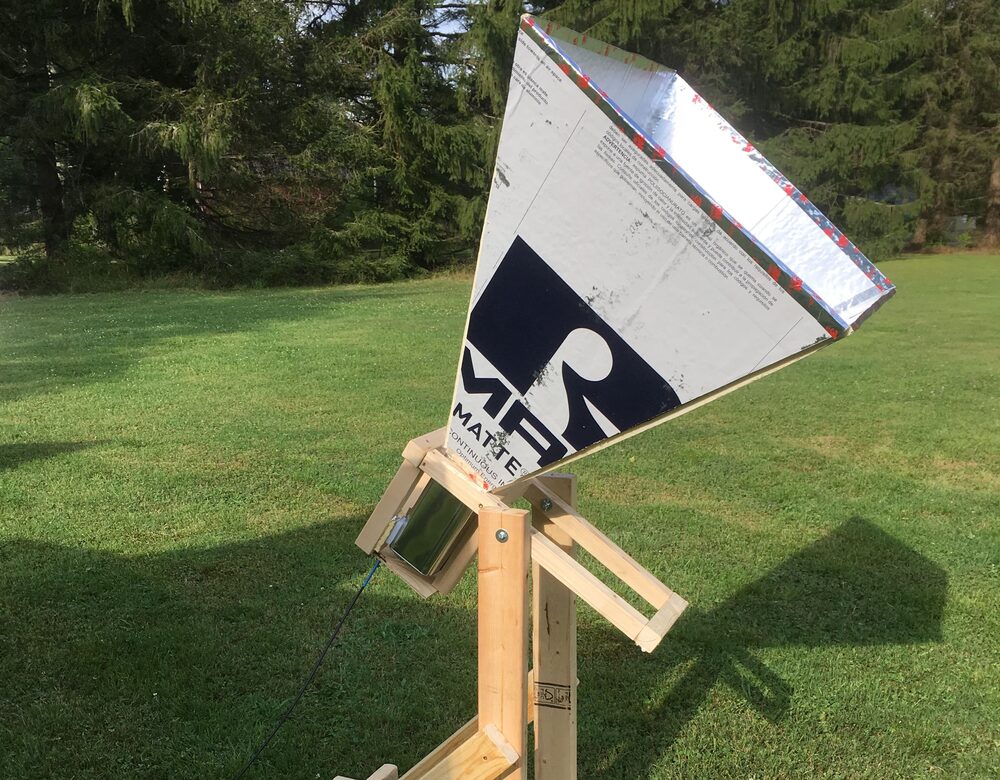
The descriptions below link to purchasing information and assembly instructions for each part.
The Antenna
The antenna consists of the horn panels, a metal can, the wire probe, and a low noise amplifier.
The horn panels and metal can are assembled as a single unit. Detailed instructions on the parts involved and their assembly can be found here.
The low noise amplifier (LNA) connects to the antenna probe through an SMA connector. This connector belongs to the can assembly. (See above.)
Some options for obtaining a low noise amplifier include the following. All of these will work with the DSPIRA horn telescope and software.
-
Best option: the DSPIRA LNA. WVU Professor Kevin Bandura designed this amplifier for a 1420 MHz radio telescope. This option requires ordering the circuit board and components, and then assembling the components by soldering. Details on ordering the parts and instructions on how to solder the circuit are provided here.
The total cost for the parts of this circuit is approximately $30.
- Next best option: Low Noise Amplifier Filtered Hydrogen Line 1420 MHz LNA 32 dB Gain LNA with Bias Tee; $54.
- Next best option: Nooelec SAWbird+ H1. This module combines a SAW filter and cascaded low-noise amplifiers for hydrogen line observations; $44.95.
The Support Stand
The support stand described here is intended to be simple and affordable to anyone. It can be constructed out of standard lumber that can be found at any home improvement store.
It consists of a cradle that holds the horn/can assembly and a base to support the cradle.
Details on how to construct the stand shown in the picture above are provided in the document here.
The cost of the parts is under $50.
The Back-end Electronics
A software defined radio (SDR) digitizes the horn’s radio signals. Digital signal processing software then processes those samples.
The SDR we prefer is the Airspy R2, $169. This operates with a 10 MHz bandwidth and is the SDR that the DSPIRA software is coded for.
A less expensive option is the Airspy Mini, $99. It operates with a 6 MHz bandwidth. Only a minor adjustment to the software is needed if this SDR is used. Contact us for more information about the changes that would need to be done.
A coaxial cable is needed to connect the LNA to the SDR. Refer to the diagram above. Typically a 10 ft length is adequate, but any length up to 25 ft should work fine.
The SDR comes with a cable for plugging it into a USB port on the computer. The spectrometer program on the computer is run on GNU Radio, which is a free and open source software program. Information about setting up the computer with the necessary software can be found here.