
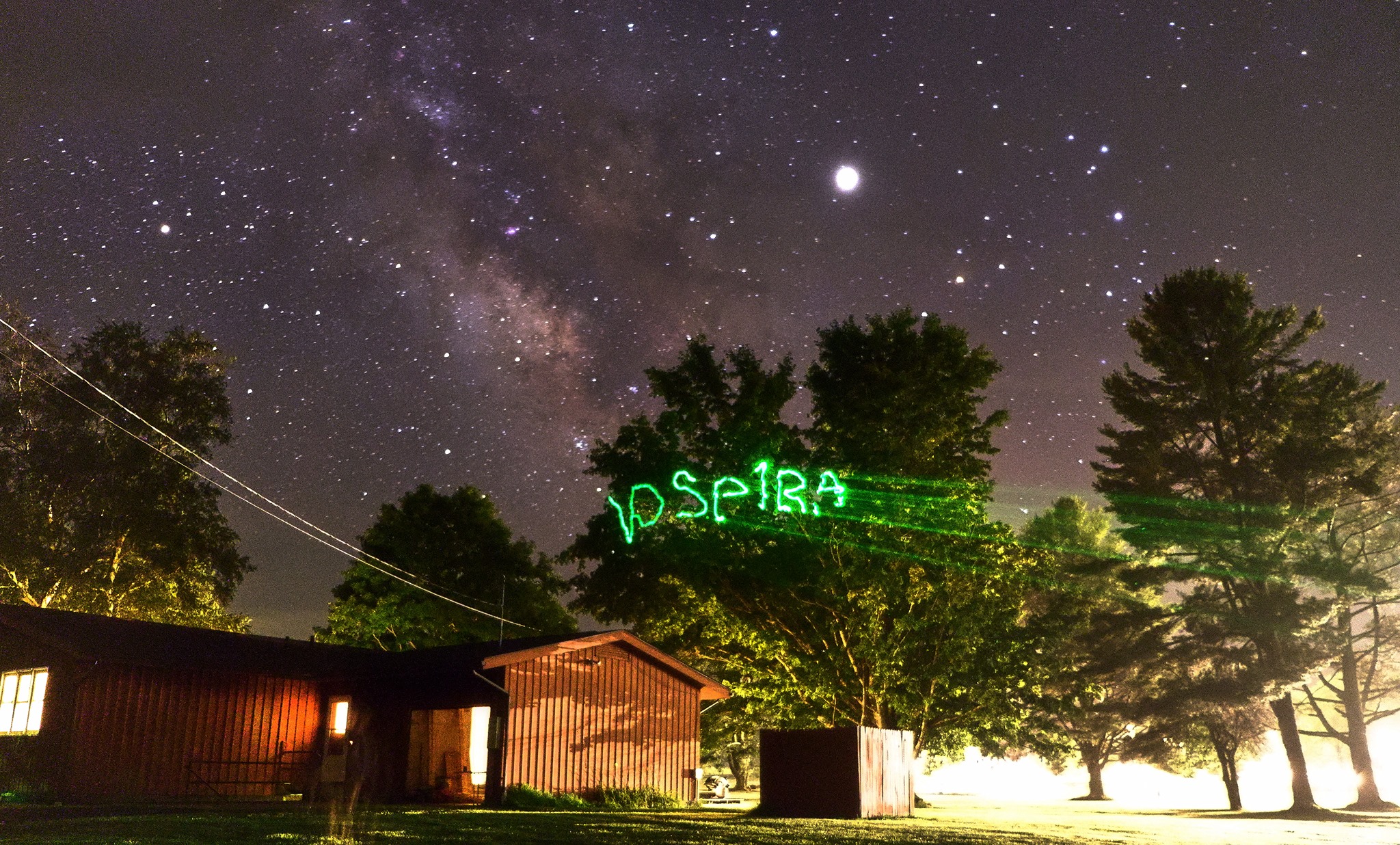
 DSPIRA Summer Session - July 2019 - Green Bank, West Virginia
At the heart of the DSPIRA Experience is the development of the Radio Horn Telescope. We can build an inexpensive device that reveals secrets carried by radio waves from space. A starter telescope cannot reveal everything that Hubble can. Similarly, the DSPIRA Horn Telescope detects only the brightest radio sources.
The Milky Way provides a bright radio source for the DSPIRA Horn Telescope. This activity sequence introduces our galaxy and explores what its radio waves reveal.
Click here for a complete document of Teacher’s Notes for this whole activity sequence
Activity List
- How Fast Are We Moving?
- Celestial Coordinate Systems
- Using Stellarium to Find the Galactic Center
- Introduction to the Milky Way - What can we see?
- Introduction to the Milky Way - What CAN’T we see?
- A Model of the Motion within the Milky Way
- Creating a Velocity Curve for the Milky Way Galaxy
1. How Fast Are We Moving?
This activity may have already been done as a stand alone, or as part of the Earth’s Motion sequence. Students determine the Sun’s speed around the Milky Way. They can complete the activity now or recall their earlier result.
Click for link to How Fast Are We Moving? page
2. Understanding Celestial Coordinate Systems
If the students are heading towards making observations from their location, a basic lesson of coordinate systems is needed. Galactic Coordinates are covered here.
This, too, is a separate stand alone lesson within this DSPIRA space.
Click for link to Understanding Celestial Coordinates page
3. Using Stellarium to Find the Galactic Center
This activity connects to the Earth Motion lesson sequence. It also provides a starting point for sky observations.
STELLARIUM NOTE: Several planetarium programs are available. These activities use Stellarium, the program used by DSPIRA teachers.
USE DOWNLOAD VERSION Install Stellarium on the computers you will use to investigate the Milky Way with the horn telescope. It will make the student’s observation planning much easier.
Video (to be created) - Planning for a Horn Telescope Observation - From choosing an object to pointing the Horn at it
Click here for Student Activity Using Stellarium to Find the Galactic Center student worksheet
4. Introduction to the Milky Way - What can we see?
Just a basic chance for the students to get basic information about the Milky Way off the internet. There is also a first pass at understanding the Galactic Coordinate system used for studying the Milky Way.
Click here for Student Activity Introduction to the Milky Way - What can we see? student worksheet
5. Introduction to the Milky Way - What CAN’T we see?
The name is hopefully not misleading, because there is lots that we can’t see. This activity looks at MOTION as “the thing we can’t see” (without understanding the Doppler Effect)
Click here for Student Activity Introduction to the Milky Way - What CAN’T we see? student worksheet
Computer Simulation of Galactic Motion
6. Modeling the Motion of the Milky Way
This paper model helps students determine stars’ relative radial speeds at different locations around the Milky Way. A collaborative class effort can produce a model very similar to current research in Milky Way Astronomy
Click here for all 3 Student documents —–> Modeling the Motion of the Milky Way student worksheet —–> Spreadsheet —–> Model Diagram
Here are 3 helpful video companions MWG Model - Part 1MWG Model - Part 2MWG Model - Part 3
7. Creating a Velocity Curve for the Milky Way Galaxy
This final activity lets teachers and students collect galactic data. A separate lesson sequence on the Lesson Module Page explains the process.