
This intensive activity sequence is intended for high school students and above. Students eventually use the DSPIRA Radio Horn Telescope to measure Earth’s speed around the Sun. The reference point to measure this speed with be the Center of the Galaxy (GC).
Click here for a complete document of Teacher’s Notes for this whole activity sequence
There are (up to) 6 activities to get to using the Horn Telescope
Activity List
- How Fast Are We Moving?
- Modeling Earth’s Motion Around the Sun
- Earth’s Motion With Respect to Galactic Center
- A teacher created Doppler Effect Lesson -(Currently, no DSPIRA Activity here)
- Analyzing DSPIRA Radio Horn Data
- Comparing Model to Data
- Getting your own data with your Radio Horn
1. How Fast Are We Moving?
This standalone exercise suits students from middle school space science through high school physics. Students determine Earth’s rotation speed, its orbital speed around the Sun, and the Sun’s speed around the galaxy. To get to the activity files, click here How Fast Are We Moving?
2. Modeling Earth’s Motion around the Sun
The Earth will be modeled as moving in a circle around the Sun. The direction to the galactic center (GC) is included for use in later measurements. Later Doppler calculations require Earth’s velocity component toward the GC. This activity introduces velocity components graphically.
Click here for Student Activity Modeling Earth’s Motion around the Sun student worksheet
Click here for Student Activity Diagram
Modeling Earth’s Motion around the Sun teacher video Video for Activity
3. Earth’s Motion with respect to the Galactic Center
The previous activity produced an Earth orbit model. Its numbered days now need actual calendar dates. Use Stellarium Web Online to connect calendar dates with the student’s model.
Click here for Student Activity Earth’s Motion with respect to the Galactic Center student worksheet
Earth’s Motion with respect to the Galactic Center teacher video Video for Activity
Stellarium - Web vs Download Version
Stellarium helps observers explore the night sky. Teachers can also use it for interactive astronomy lessons.
For the full DSPIRA telescope-building experience, consider learning the more capable downloadable version (still free). Watch the video for a DSPIRA opinion on Pros and Cons for each version.
Video Stellarium Web vs Download version
4. Introduction to Doppler Effect
There is not a DSPIRA generated activity for Doppler. The next activity uses the Doppler equation provided in its instructions. Introduce the equation in a lecture first.
This three-minute video introduces the Doppler shift. Its final minute explains how astronomers use the effect to detect motion.
Popular Youtube Doppler Shift Video
5. Measuring the Earth’s Speed around the Sun
Actual data generated from the DSPIRA Radio Horn Telescope is given to the students to analyze. It is a great opportunity for students to learn to dig information out of a graph. The data lines up with the points created in the Earth Orbit Model from activity #2. The students will use the Doppler equation to determine the (radial) speed of the Earth towards the Galactic Center.
Click here for Student Activity Measuring the Earth’s Speed around the Sun student worksheet
The following video shows an example of how to analyze the Spectrum in the manner of the activity. It can help the teacher or student get started with the analysis part of the activity. Video of Graph Analysis Example
6. Comparing the Earth Orbit Model to the actual Data Analysis
There has been a long sequence of activities that brings a class to this point. Students summarize their work in one Conclusion/Final Comparison chart.
Open the Comparing the Earth Orbit Model to the actual Data Analysis student worksheet. Students working independently will find slightly different differences between their model velocities and the measured data. Collect the class results and discuss them together. Teachers can copy this spreadsheet and share it with students. Students can then enter their data together. Their data on the spreadsheet has typically yielded a nice histogram. Students and teachers can quickly compare individual results with the rest of the class. There is an example worksheet (lower tabs) to look at once the spreadsheet is open.
Click here Class Data Spreadsheet
7. Students Gathering Data
A working DSPIRA Radio Horn Telescope lets students collect their own galactic-center data. They can analyze its spectrum using the same methods as before (activities 2, 5, and 6)
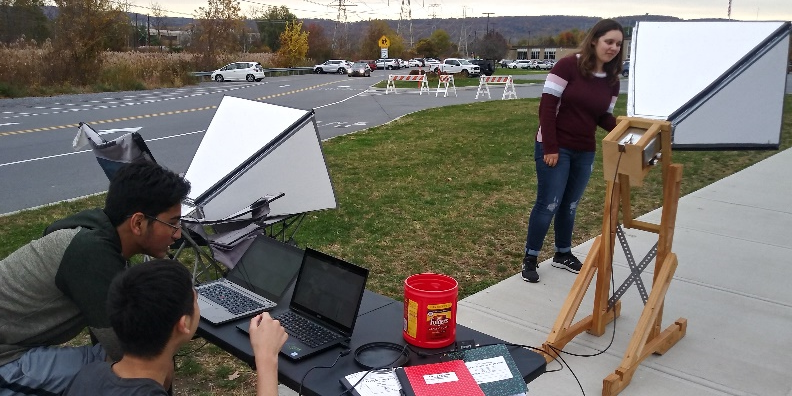
Students Observing the Galactic Center with a Radio Horn. The Observing module covers choosing a target, setting up the telescope, and taking observations. Setting up the Telescope provides the video. Horn Operation Tutorials collects the remaining walkthroughs.